
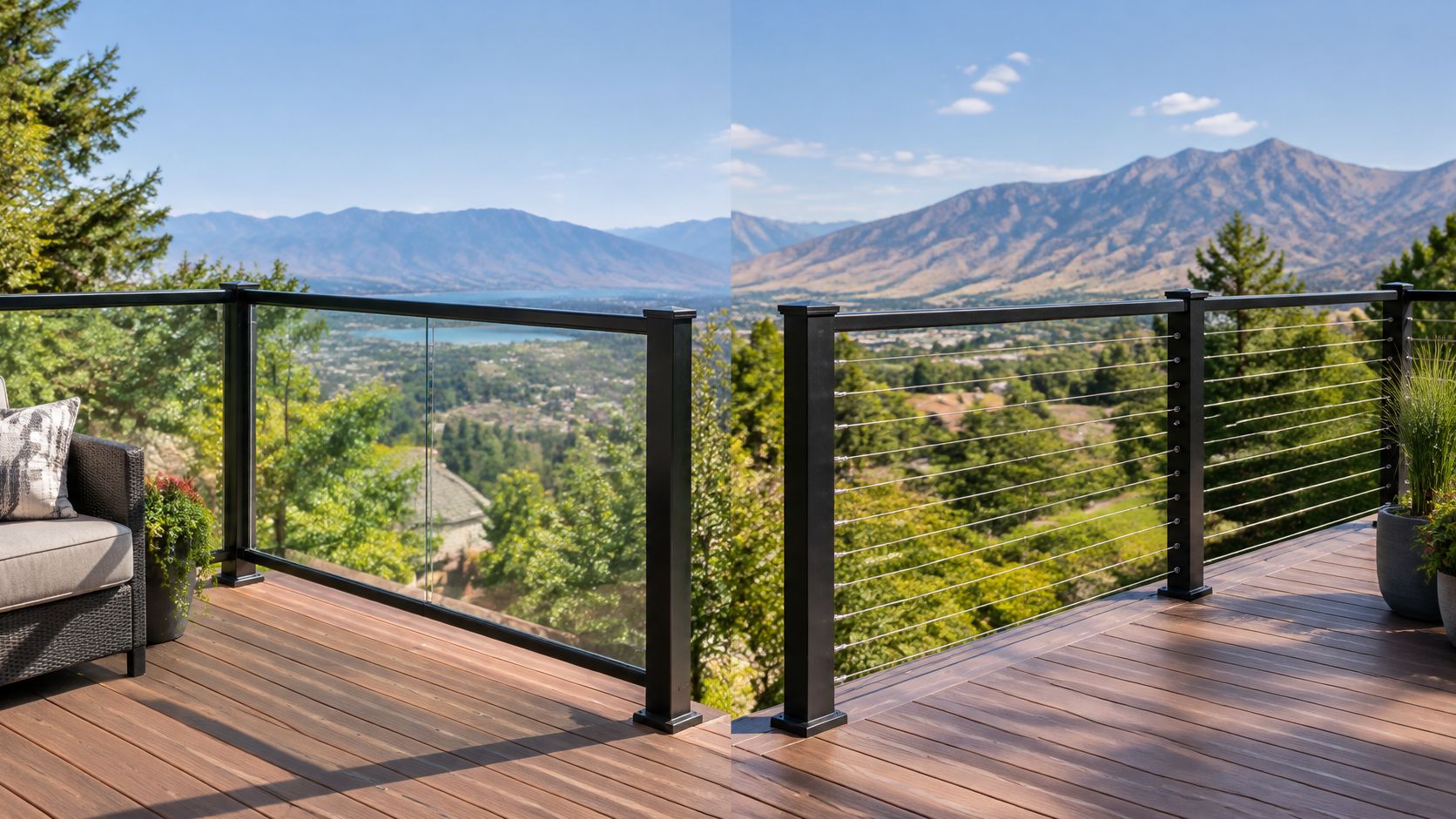
A deck can face the mountains and still be difficult to enjoy when wind, reflected sun, or dirty railing panels interrupt the view. Glass railing vs cable railing comes down to the site and the upkeep the household will accept, not which sample looks more transparent indoors.
Glass or Cable Depends on the Site
Cable suits an open, view-first deck where airflow is welcome and someone will monitor fittings and openings. Glass suits a deck where a continuous barrier matters enough to justify panel cleaning and specified safety glazing. Neither material name is a code approval, and blocking a breeze isn't an engineered wind rating.
Hypothetical site comparison: A west-facing Herriman deck with afternoon sun and a dog presents different priorities from a sheltered Provo patio aimed at the mountains. The exposed deck calls for closer attention to glare, containment, and wind exposure; the sheltered site may put more weight on the seated sightline.
Selection rule: Choose the infill around the actual exposure and household, then evaluate the complete guard assembly.
Broader material planning resources, including outdoor decking advice from NorCal Construction, can help organize the surrounding deck choices. The infill decision still needs its own review of deck railing systems, cleaning access, failure behavior, and site dimensions.
Utah View Wind and Cleaning Tradeoffs
Utah exposure view and cleaning choices
| Site condition | Open cable infill | Glass panel infill | Wasatch Front note |
|---|---|---|---|
| Wind on a canyon bench or hilltop | Air passes through; openness isn't a wind rating | A solid panel can block breeze and interrupt drifting snow at the rail; that isn't an engineered wind rating | Comfort and exposure are separate from the tested guard assembly |
| Primary view | Thin lines cross the view | A continuous clear panel until dirty or reflective | Compare seated valley and mountain views across Salt Lake County |
| Low western sun | Little glare from the cables themselves | Panels can mirror sun and bright snow | Check west-facing exposures in South Jordan or Herriman |
| Dust water and snow film | Less face area collects debris; fittings still need cleaning | The whole panel shows dust, mineral spots, and snow film | Consider spring dust and winter road splash |
| Pets and small children | Openings must remain within the applicable guard limit under load | A continuous barrier only while the specified system remains intact | Review climb paths and small pets on site |
| Snow and ice at the rail | Ice accumulation warrants attention at cables and hardware | Edges and faces can hold film and ice | Neither material name establishes approval |
The view row deserves a seated check, since a standing glance at a sample misses how the infill reads from a chair. Cable lines stay visible against the surroundings, while glass clarity shifts with reflections, surface deposits, and viewing angle. A panel that looks clear under showroom lighting can read differently with low western sun behind the observer.
Prioritize the conditions that occur on this lot
A sheltered yard calls for a different comfort strategy than a canyon-facing balcony, and the rows above should be weighted by how often each condition shows up on a given lot. An owner who dislikes water spots should weigh the cleaning row heavily: dust, mineral spots, and snow film build across the full face of a panel between washings, while cable leaves less surface to wipe but adds fittings to clean around.
The railing insights from Utah Deck Supply provide additional context for evaluating glass around the home. Mark the conditions that matter most before comparing packages.
Railing can be a major cost swing: aluminum, steel, composite, cable, glass, vinyl, and gates all price differently. A per-foot guess misses the actual configuration; a materials quote starts from real dimensions and a chosen system.
Guard Loads and Failure Behavior
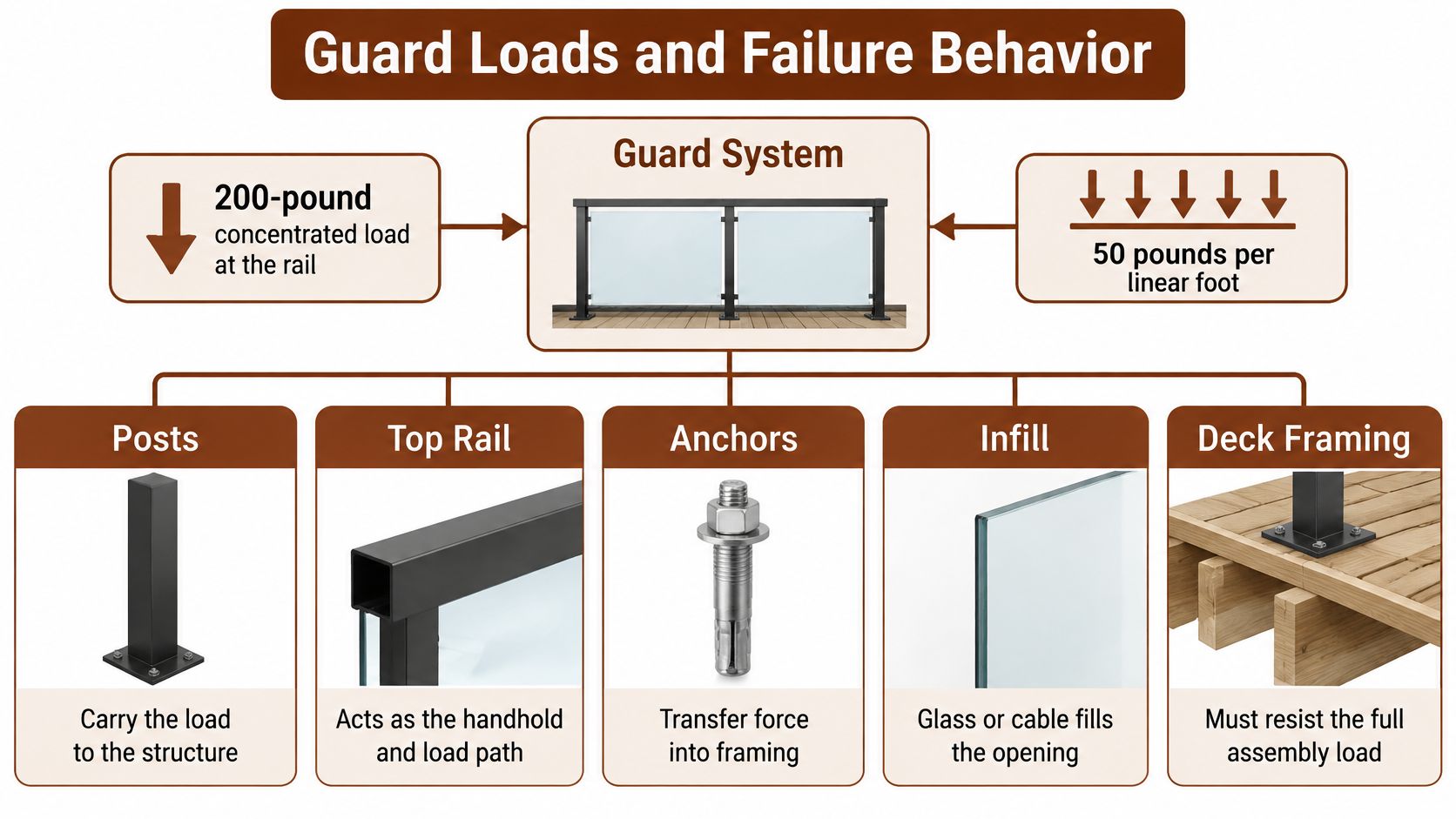
A guard can look solid and still fail at a bolt, a post base, or a clamp. The guard is an assembly: posts, top rail, anchors, infill, and the deck framing that supports them all share the load. A weak connection governs performance even when the visible infill looks substantial.
Common residential benchmarks include a 200-pound concentrated load at the top rail and a 50-pound-per-square-foot horizontal load on guard infill, with the complete assembly and project-specific provisions controlling review under ASTM E2353 system guidance. That standard evaluates glass railing static strength, impact performance, and post-breakage retention, including glazing supported on one to four sides and assemblies attached to wood, metal, masonry, or concrete.
A system diagram should show where each load path goes before a package is priced.
Glass needs a post-breakage answer
Panel thickness alone doesn't answer what happens after an impact. Glass construction, edge conditions, supports, clamps, and retention details determine whether the barrier performs as specified after fracture.
The National Glass Association guardrail guidance addresses a 50-pound-per-linear-foot load as well as safety glazing and post-breakage behavior. That linear-load figure is not interchangeable with an infill area load, so the designer has to confirm which requirements apply to each element under the adopted code.
A glass quote should identify the glazing construction and the supported system rather than offering a clear panel of a particular thickness. Replacement glazing also needs to match the approved assembly, not only fit inside the opening.
Cable needs an opening and end-post answer
Cable fails differently. Loose cables and flexible posts let an opening enlarge under pressure, while pretension transfers force into end posts and their connections.
The adopted code's 4-inch sphere rule has to hold under loaded conditions, including the pressure of a body against the lines, rather than only in the cables' resting state. Spacing that looks correct on a quiet afternoon can open past the limit when someone leans on the guard, which is why cable spacing alone does not establish compliance.
Pretension also explains the attention end posts get in engineering illustrations: each tensioned run adds its pull to the post, and a guard with many runs multiplies that force well beyond the tension in any single cable. Treat any such figure as a reminder about accumulated force rather than a Utah design load or a tensioning instruction.
A strong cable doesn't compensate for a weak end post, and intact glass doesn't prove its anchors are adequate.
Observe problems without load-testing the guard
A no-tools visual review tells an owner plenty without leaning into a suspect assembly or trying to prove its strength:
- Glass edges and clamps: Look for chips, cracks, shifted panels, displaced gaskets, or visibly loose retainers.
- Post connections: Note movement, corrosion, separated trim, or visible deterioration around the mounting area.
- Cable condition: Flag visibly slack lines, damaged strands, and inconsistent alignment.
- End fittings: Look for missing parts, displaced fittings, or changes since the previous inspection.
- Opening control: Have questionable gaps assessed against the required loaded-condition test rather than judging unloaded spacing by eye.
Visible damage or movement calls for qualified assessment, not improvised tightening or a homeowner load test. Installation quality can matter as much as the initial infill choice.
Before ordering, verify the manufacturer's tested span, post spacing, anchorage, and stair configuration. The Utah Deck Supply railing guide distinguishes mounting approaches, and either approach still depends on a verified assembly rather than a mix of unmatched components.
Corrosion Snow Glare and Cleaning
Stainless cable isn't a complete specification. Alloy, finish, exposure, and installation all affect how the metal performs. The manufacturer should confirm the suitable cable and hardware specification for the actual site, especially where winter road splash or deicing products may reach the railing.
A 2022 case study of 316L stainless steel in Genoa, Italy, published by the American Society of Civil EngineersAE.1943-5568.0000554), found chloride-related intergranular corrosion and significant localized metal loss associated with an unsuitable rough finish in a marine-urban atmosphere. That's a caution about specification and surface finish, not a Utah corrosion rate or a reason to prescribe a particular alloy for every Wasatch Front deck.
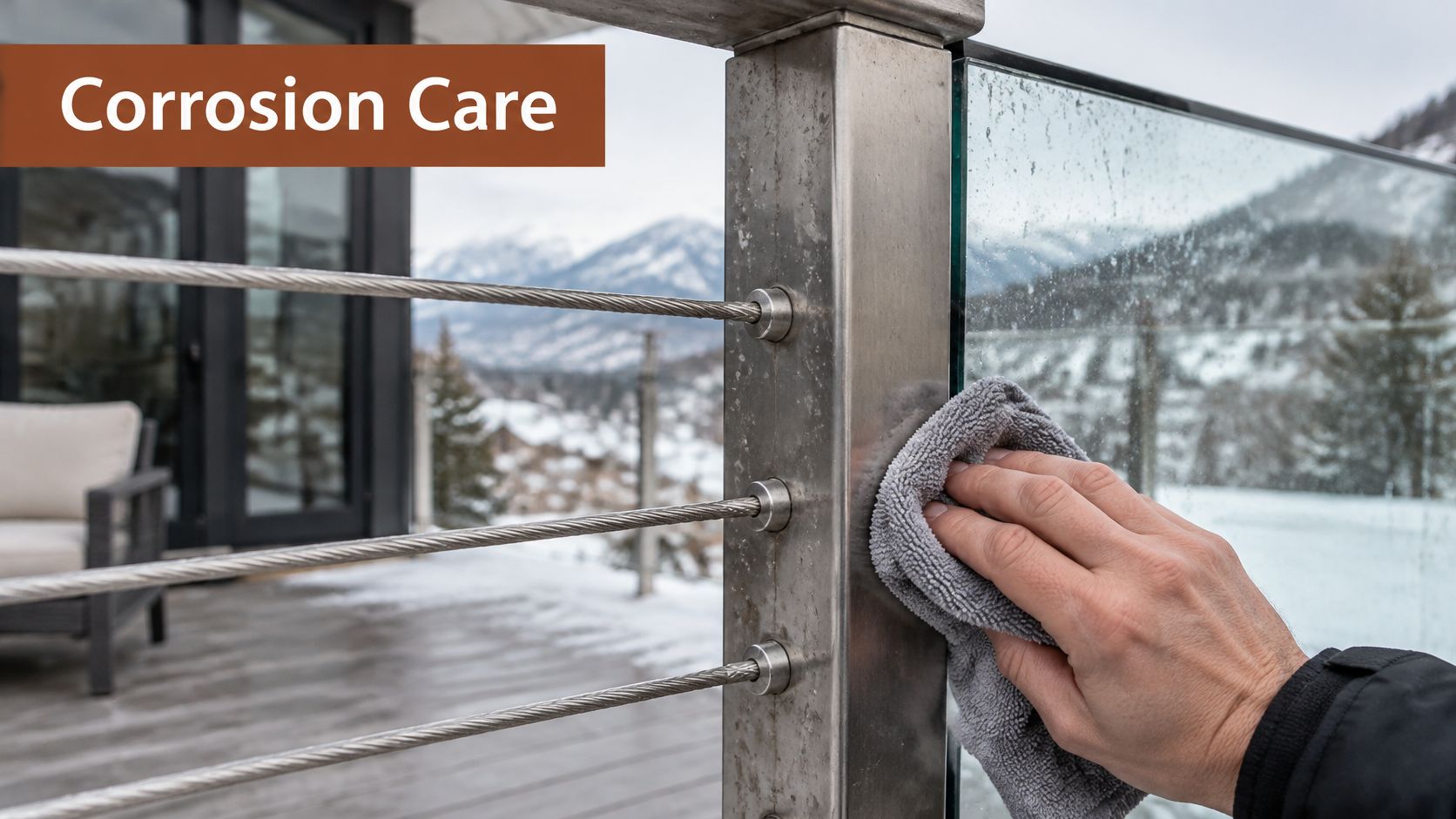
Winter upkeep includes the metal supports, not just the infill.
Match the upkeep to the household
Glass doesn't rust, but its hardware still needs attention. Dust, mineral deposits, fingerprints, and snow film affect the appearance of the whole panel; chips and scratches also warrant attention rather than being dismissed as cleaning problems.
Cable presents less face area to wash, but it isn't maintenance-free. Fittings, posts, and cable condition still need the inspections and care specified by the manufacturer.
- For glass: Plan safe access to both faces and a way to observe edges and supports.
- For cable: Establish who will check fittings and arrange manufacturer-directed tension assessment.
- For either system: Obtain the product-specific care instructions before selecting cleaners or tools.
For general window-cleaning context, Pine Country Window Cleaning's glass care guide is a useful companion, not a substitute for railing-specific instructions.
Bright-day reflections are a visibility and comfort issue, not a structural rating. Cleaning can remove deposits; it can't eliminate the optical behavior of clear glass.
Which Deck and Household Fits
Cable fits a household that prioritizes a thin, open view and accepts ongoing opening and fitting checks. It isn't a set-and-forget containment system. Children's climbing routes, furniture near the guard, and small pets need a site review rather than an assumption based on product photography.
Glass fits a household that places more value on a continuous panel and accepts the work of keeping it clear. Bottom gaps, panel joints, gates, and adjacent structures still deserve attention. A continuous face doesn't make the entire deck pet-proof or remove the need for supervision.
Deck boards aren't guard anchorage
Composite, PVC, and wood boards can accompany either infill, subject to the selected system's requirements. The walking surface doesn't establish guard capacity: structural posts, blocking, connections, and anchorage must follow the manufacturer's details and local requirements.
Fascia and skirting are cladding, not substitutes for structural anchorage. Existing decks need an assessment of what sits behind those finished surfaces before a replacement railing is selected.
Household fit: The right infill is one the household can use, inspect, and maintain without relying on assumptions about strength or containment.
Utah Deck Supply carries Trex, TimberTech, Fortress, RDI, Cinch, and RailFX railing. RailFX offers premium cable and glass systems for unobstructed views; TimberTech offers aluminum and composite railing with clean sightlines and infill options from cable to glass. The selected configuration still needs its own technical review.
The business doesn't sell aluminum decking boards or aluminum deck planks. Aluminum railing is a separate product lane alongside composite, PVC, and wood deck-board choices; owners can compare metal deck railing systems without confusing railing materials with decking.
Comparing finishes beside actual boards in the West Jordan showroom helps resolve color and sightline preferences. Both infill types require careful system planning, and a qualified installer should address installation rather than treating either as a simple decorative upgrade.
Questions Owners Ask Before Ordering
Can ordinary window glass be used if it looks the same?
No. The 2021 International Building Code safety-glazing provision requires guard and handrail glass to be laminated from fully tempered or heat-strengthened glass, meet CPSC 16 CFR Part 1201 Category II or ANSI Z97.1 Class A, and have a minimum nominal thickness of 1/4 inch. It permits single fully tempered glass only in limited cases without a walking surface below or where that surface is permanently protected from falling glass.
The locally adopted edition and project conditions govern. That minimum isn't a panel-selection recommendation or confirmation that a particular support arrangement works.
Does a solid panel or tight cable layout mean city approval?
No. A photograph, materials quote, or attractive sample isn't a permit or a structural evaluation. The authority having jurisdiction reviews the submitted assembly against applicable requirements.
The submittal should identify the actual components and mounting conditions. Substituting posts, clamps, fittings, or glazing can change what the documentation supports.
Will the supplier install or repair the railing?
No, the service described here is materials selection and quoting, not an installation or repair engagement. Utah Deck Supply is a West Jordan materials supplier and showroom serving homeowners, DIY builders, and contractors, not primarily an installation or repair contractor. Installation assessment and corrective work belong with qualified professionals.
Measure the Infill Before You Quote
Pre-quote infill checklist
| Item to confirm | Why the infill changes | What to record |
|---|---|---|
| Mounting surface and post material | Wood framing, steel, or concrete changes the anchorage review | Framing or post material notes |
| Straight run length and post spacing | Panel width and cable-run design rely on span | Rough dimensions or a sketch |
| Corners and direction changes | End posts and glass joints differ from a straight run | Corners marked on the sketch |
| Stairs and slope | Stair glass and angled cable require separate layouts | Stair count, rise, and slope notes |
| Guard height and walking surface below | Falling-glass conditions affect glazing review | Notes on lower patios or grade |
| Wind exposure and view priority | Open versus solid sets breeze and comfort; wind rating is a property of the engineered assembly | Canyon, hilltop, or sheltered yard |
| Pets, children, and cleaning tolerance | Opening control and panel washing affect suitability | A short household-use note |
A rough sketch should distinguish existing conditions from proposed changes. Record uncertain dimensions as unconfirmed so an estimate never becomes a fabrication measurement. The post-spacing layouts in railing material planning for Utah deck builders give useful context for marking runs, corners, and end-post locations before quoting.
Dimensions, optional site photos, and board preferences help build the materials list. Physical finish comparisons work best beside real composite, PVC, or wood samples, where a cable fitting or a glass channel can be held against the deck board color it will frame. Exposure, traffic, shade, snow, view lines, and maintenance expectations guide selection, and comparing two or three product lines side by side settles most decisions faster than a catalog page.
Cable favors a thin, open view when its openings and end-post system are properly designed. Glass favors a continuous barrier when specified safety glazing and panel cleaning are acceptable. Local review of the actual assembly and site conditions decides approval for either system.
For help comparing infill and assembling a free materials quote, visit Utah Deck Supply, a West Jordan supplier and showroom for decking, railing, hardware, and outdoor structures. Bring a rough layout and measurements to the showroom, or request the free quote through the site once the infill list is settled.